
How AI Creates Microlearning Modules From Long Documents
Microlearning modules turn long documents into short, focused units that teach one objective and include practice. AI speeds this up by analyzing a document's structure, proposing learning objectives,…
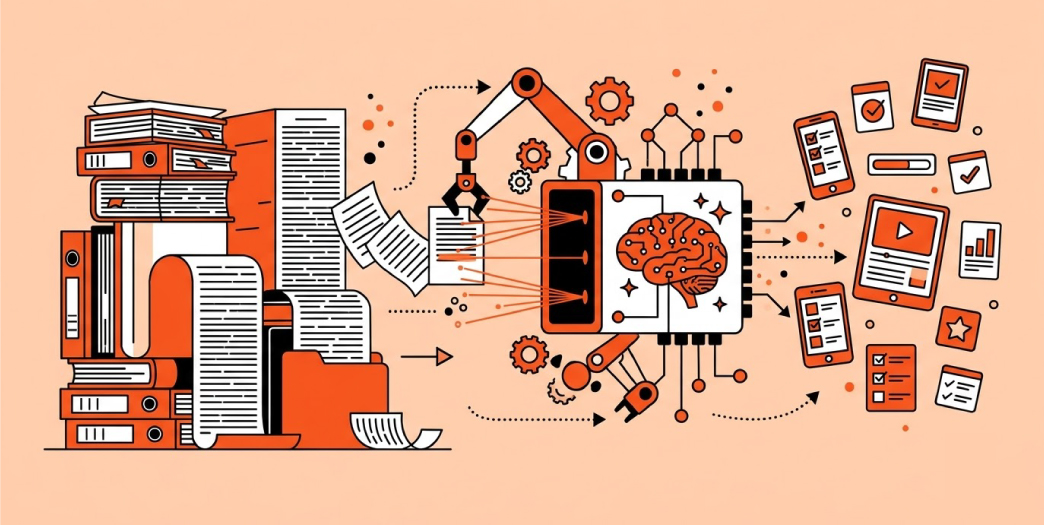
Microlearning modules turn long documents into short, focused units that teach one objective and include practice. AI speeds this up by analyzing a document's structure, proposing learning objectives, grouping content into bite sized learning units, and drafting practice questions, while a subject matter expert reviews for accuracy. Paired with live sessions and job aids as blended online learning modules, this approach helps teams convert documents into eLearning. BrinX delivers SCORM or xAPI compliant courses through AI plus instructional design review.
Introduction
A new policy lands: 60 pages, carefully written, fully approved. HR sends it company-wide with a request to "read and acknowledge." A week later, completion is high, and understanding is low. People scrolled to the end and clicked the box. Nobody can say what they would do differently on Monday.
This is the everyday problem behind most training backlogs. The knowledge exists, but it lives in documents built for reference, not for learning. This guide explains how AI turns long documents into microlearning modules, what makes bite sized learning effective, how to blend modules with other formats, and where a person still needs to review the result.
Why Long Documents Fail as Training
A long document is built to be complete, not to be learned. It lacks sequence, practice, and feedback, and it asks learners to hold too much in mind at once. The result is exposure to content without evidence of understanding.
- No learning path. Documents follow the author's structure, such as scope, definitions, exceptions, and appendices. Learners need the opposite: the few things that matter most, in the order they will use them.
- Too much at once. When every rule arrives together, nothing stands out. Research reviewed in Heliyon links microlearning design to the limited information working memory can hold at once, which is the reason to break content into small units.
- No practice or proof. Reading is passive. Without questions, scenarios, or decisions, neither the learner nor the organization knows whether anything stuck.
Microlearning is the usual response. One scoping review of the research by Taylor and Hung describes it as a form of e-learning "delivered in small chunks" focused on skill-based, just-in-time knowledge. The same review is candid that evidence on effectiveness was unclear when the field began to grow, which is a useful reminder that format alone does not guarantee results. Design does.
What Makes Good Microlearning Modules?
Good microlearning modules are short, focused on one objective, self-contained, and interactive. Size is only part of the answer. A short module that teaches nothing is still a failure, so each one needs a clear outcome and a way to check it.
A 2025 systematic review in Heliyon, led by Monib, Qazi, and Apong, concluded that the reviewed studies indicate microlearning has a positive impact on learning outcomes. The authors also describe effective microlearning content as "bite-sized, multisensory, interactive, personalized, and self-contained" (Heliyon, via PubMed Central). The same paper notes that results across studies are scattered and mixed, so treat the evidence as encouraging rather than settled.
| Design element | What it means in practice | Why it matters |
| One objective | Each module teaches a single, specific skill or decision | Keeps focus and makes success measurable |
| Self-contained | A learner can finish it without other modules | Supports just-in-time use |
| Interactive | Questions, choices, or scenarios inside the module | Turns reading into practice |
| Sequenced | Modules connect into a path when needed | Prevents fragmented knowledge |
| Multisensory | Text with visuals, narration, or short video where useful | Supports different ways of learning |
How Does AI Convert Documents Into eLearning Modules?
AI powered learning starts with a simple step: AI reads a source document, identifies its structure, proposes learning objectives, groups related content into short modules, and drafts practice questions. A person then reviews the draft for accuracy and relevance. The result is a first version of the course in a fraction of the usual effort.
Step 1: Choose the Right Source Document
Good eLearning content development starts with the right source. Not every document deserves to be converted, so begin with content that is current, used repeatedly, and tied to real performance: policies, procedures, product knowledge, and onboarding material. Confirm which version is the source of truth before anything is processed.
Step 2: Extract Structure and Objectives
AI analyzes headings, sequences, definitions, and rules, then proposes what a learner should be able to do after each section. This is the heart of any effort to convert documents into eLearning. The objective, not the page count, decides what belongs in a module.
Step 3: Chunk Content Into Microlearning ModulesInto Microlearning Modules
Related ideas are grouped into small units, each tied to one objective. Background and exceptions are moved out of the main path or into optional material. The goal is bite sized learning that respects a learner's time without cutting the substance.
Step 4: Add Practice and Media
Each module gets at least one question, scenario, or decision. Where a concept is hard to picture, a visual or a short narrated explanation helps. This step turns a summarized document into AI powered learning that learners actually do something with.
Step 5: Subject Matter Expert Review
An expert checks facts, thresholds, and terminology against the source. This step is not optional. AI is fast at structuring, but only a person who knows the work can confirm that the module teaches the right thing the right way.
Step 6: Package and Test
Export the modules in a format your LMS accepts, upload to a test course, and run through it as a learner. Confirm navigation, media, and completion tracking before launch.
The time savings are why this approach is spreading. ATD's 2025 research found that 80 percent of instructional designers use AI tools and that 37 percent of TD professionals say AI greatly reduced the time it takes to design a course. That matters because traditional eLearning content development is slow. Chapman Alliance benchmarking, summarized by eLearning Industry, puts the range at "about 49 to over 700 hours" to produce one hour of finished eLearning, a figure that dates from 2010 but still explains why backlogs form.
How Do Blended Online Learning Modules Fit In?
Blended online learning modules combine formats, such as short self-paced modules, live sessions, and on-the-job references, into one path. Microlearning modules handle the knowledge. Live sessions handle discussion and judgment. Job aids handle the moment of need.
Blending works because each format does a different job. A document converted into short modules can carry the core knowledge on its own schedule. A facilitated session can then focus on scenarios and questions instead of reading content aloud. A one-page checklist supports the task itself.
| Format | Best role in a blend | Example |
| Microlearning modules | Build core knowledge in short sessions | A five-part policy broken into modules |
| Live or virtual session | Practice judgment and discuss exceptions | A manager-led scenario workshop |
| Job aid or quick reference | Support the task at the point of work | A checklist for step-by-step tasks |
| Knowledge check | Confirm understanding and flag gaps | Short quiz at the end of each module |
Plan the blend before conversion, because it changes what you cut. If a live session will cover exceptions, the modules can stay lean.
Common Mistakes When Chunking a Document
Most failures come from treating chunking as simple splitting. Dividing a document every few pages produces short pieces, not microlearning modules. Avoid these common errors:
- Splitting by page count instead of objective. Each module should answer one question: what should the learner be able to do?
- Cutting context learners need. Bite sized learning is not the same as stripped-down content. Keep the reasoning behind critical rules.
- Skipping practice. A module without a question is a short read, not a learning experience.
- Converting outdated documents. Confirm currency before you convert. Training built from a superseded document teaches the wrong thing quickly.
Where Does BrinX Fit in Document-to-Module Conversion?BrinX Fit in Document-to-Module Conversion?
BrinX is a full-service AI course creation service, not a self-serve tool. You upload your existing content, and BrinX uses AI plus instructional design review to structure it into modules and deliver a SCORM or xAPI compliant course. It can work from documents, scanned PDFs, and video, add voiceover and narration, and quizzes are available on request.
For teams that need to convert documents into eLearning at volume, that division of labor matters. Your team supplies the source material and the subject matter review, and BrinX handles formatting, structure, and delivery. BrinX can also help create job aids alongside the course, which supports the blended approach described above.
The approach has been used at scale. A global bank converted more than 100 process SOPs into training for operations teams across Southeast Asia and reported saving over 80 percent of the time.
Key Takeaways and Conclusion
- Long documents are built for reference, not learning. They lack sequence, practice, and proof of understanding.
- Good microlearning modules are focused on one objective, self-contained, and interactive.
- AI powered learning speeds up eLearning content development by extracting structure, proposing objectives, and drafting practice, but an expert must review every module.
- Blended online learning modules combine short modules, live sessions, and job aids so each format does the job it does best.
- Evidence for microlearning is encouraging but mixed, so design quality matters more than size alone.
Every organization holds knowledge in documents that people do not read closely. AI powered learning makes it practical to turn that material into short, structured, trackable modules without rebuilding each course from scratch. The result is training people can finish and use.
BrinX is a full-service AI course creation service. You upload existing content, and BrinX uses AI plus instructional design review to deliver a SCORM- or xAPI-compliant course, with voiceover and narration available and quizzes on request. Pricing is pay-as-you-go or subscription. Try BrinX.ai and turn your next long document into learning people complete.
FAQs
What are microlearning modules?
Microlearning modules are short, focused learning units that teach one objective and can be completed in a few minutes. They are typically self-contained, interactive, and designed for just-in-time use rather than long, one-sitting courses.
How can AI convert documents into eLearning?
AI analyzes a document's structure, proposes learning objectives, groups related content into modules, and drafts practice questions. A subject matter expert then reviews the draft for accuracy before it is packaged and tested in your LMS.
How long should bite sized learning modules be?
Most are a few minutes long, but length matters less than focus. Each module should teach one objective and include a way to check understanding. If a topic needs more time, split it into connected modules.
What are blended online learning modules?
Blended online learning modules combine formats in one path, such as short self-paced modules, live or virtual sessions, and on-the-job references like checklists. Each format handles the part of learning it supports best.
Does AI replace instructional designers in eLearning content development?
No. AI speeds up structuring and first drafts, but designers and subject matter experts still set objectives, verify accuracy, and decide how modules fit into the wider learning plan. Their time shifts from building screens to reviewing and improving them.
Turn your content into a course
BrinX.ai converts your SOPs, policies, and training documents into multimedia-rich eLearning modules, fast.
Build your first course free