
One SOP, Five eLearning Formats: An AI Guide
AI turns a single SOP into five distinct eLearning formats at once: a full course, microlearning modules, quizzes, scenario-based games, and quick reference guides, without rebuilding content from scr…
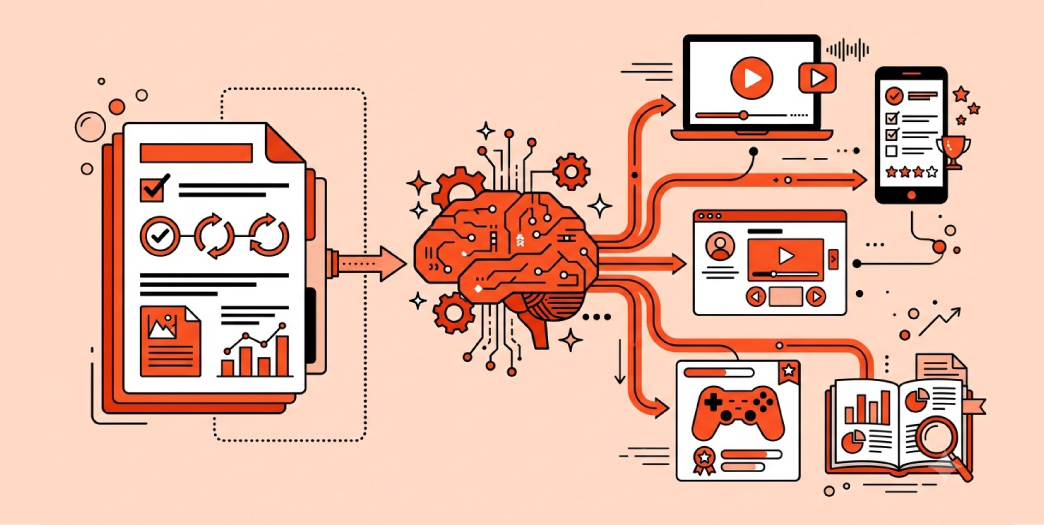
AI turns a single SOP into five distinct eLearning formats at once: a full course, microlearning modules, quizzes, scenario-based games, and quick reference guides, without rebuilding content from scratch for each one. This SOP conversion process reads the source document once, then generates each format from that same understanding, so a two-minute refresher and a complete onboarding course stay consistent with each other. For L&D teams juggling multiple training content needs across a growing document backlog, this collapses what used to be five separate authoring projects into one.
Introduction
Every L&D team knows the drill. A new SOP lands in your inbox, and suddenly you need a full onboarding course, a five-minute refresher, a quiz, and maybe a scenario-based module all built from the same document. Traditionally, that means four separate authoring projects, four review cycles, and four chances for the training content to drift out of sync with the original SOP.
BrinX.ai removes that bottleneck. One source document is processed once and turned into several eLearning formats at the same time: a quiz, a microlearning module, a scenario-based game, and a full course, all traceable back to the same original text.
This piece covers why re-authoring keeps happening, how BrinX.ai reshapes one document into different eLearning formats, what the retention data says about microlearning formats, and what to look for in AI tools for training content creation before you rely on one.
Why L&D Teams Keep Re-Authoring the Same Content
L&D teams rarely start with training content; they start with a policy or SOP and have to translate it into something learnable. This section looks at why that translation keeps happening from scratch for every new format.
- Most training content starts as an SOP, policy, or onboarding note written by operations or compliance, not instructional design. L&D's job is translating that into something learnable, and that's historically meant picking one format and building it by hand.
- No single format fits every audience: new hires need a full course, tenured staff need a two-minute refresher, and compliance needs a quiz. Learner preference is shifting fast, too; the number represents a sharp rise from 54% in 2023, referring to the share of organizations now using microlearning.
- That gap between one document and several audience needs is where most L&D backlogs are born. When the source SOP changes, four separate assets need updating independently, and it's common for at least one of them to get missed.
What BrinX.ai Actually Does With That One Document
BrinX.ai takes a single uploaded document and generates several eLearning formats from it in one pass, instead of requiring a separate authoring project for each one. Here's what that upload produces, and why the source stays consistent across formats.
- Quizzes: BrinX.ai pulls key facts, procedures, and edge cases directly from the SOP and turns them into AI-generated quizzes, useful for both knowledge checks and compliance sign-off.
- Microlearning modules: The same content broken into short, single-topic segments, typically three to ten minutes each, built for spaced repetition and on-the-job reference rather than one long sitting.
- Games or scenario simulations: Procedural steps reframed as decision points or branching scenarios, well suited to safety-critical or judgment-heavy SOPs.
- Full courses: The complete document restructured into a sequential course with objectives, sections, and assessments for onboarding or certification tracks.
Why the single-source model matters
Because every format is generated from the same underlying source, updates to the SOP get pushed through to every downstream asset instead of triggering separate manual edits. Facts and procedural steps stay identical across formats; only pacing, structure, and interactivity change from one eLearning format to the next.
The Data Behind Why Format Variety Matters
Format choice isn't just a workflow preference; it changes how much of the training content actually sticks with learners. This section walks through what the retention and completion data says about microlearning formats compared with long-form, single-format training.
The forgetting curve problem
People forget new information fast, and most of it disappears within days without reinforcement. Short, spaced content is one of the more reliable countermeasures to that decay, which is part of why microlearning formats have become the default building block for ongoing training rather than a novelty add-on.
Completion and retention gains
The completion and retention numbers back this up directly. It achieves an 80% completion rate, while long-form courses manage only around 20%. A separate research summary adds that spaced microlearning improves recall by up to 1.6x compared to massed study, reinforcing why shorter, chunked formats consistently outperform single, long-form courses on both completion and recall.
The table below summarizes how the five common eLearning formats generated from a single SOP tend to be used, and what each is best suited for.
| Format | Typical Length | Best For | Primary Metric It Improves |
| Full course | 30–90+ minutes | New hire onboarding, certification | Structured knowledge transfer |
| Microlearning module | 3–10 minutes | Refreshers, policy updates, mobile learning | Retention, completion rate |
| AI-generated quiz | 5–15 questions | Comprehension checks, compliance sign-off | Verified understanding |
| Scenario/game | 5–20 minutes | Judgment-based or safety-critical SOPs | Applied decision-making |
| Reference microcopy/job aid | Under 2 minutes | In-the-moment lookup during task execution | Task accuracy |
Where BrinX.ai Fits Into SOP Conversion
SOP conversion used to require an instructional designer to read an entire document and manually storyboard each output by hand. SOP conversion: Turning a static procedural document into interactive training used to mean reading the whole SOP and manually storyboarding every format. BrinX.ai extracts structure (steps, warnings, decision points, definitions) directly from the source text and maps it onto templates for each output format.
This pattern is accelerating across L&D with 88% reporting value via time saved on content creation. That mirrors adjacent fields with workers save an average of 2.2 hours per week using AI tools; BrinX.ai is built to reclaim that time specifically for training content creation.
That saved time gets redirected, not eliminated. Instructional designers using BrinX.ai spend it reviewing AI-generated drafts for accuracy, tone, and edge cases the source document didn't fully spell out, rather than manually reformatting the same SOP into four separate deliverables.
What "Good" Multi-Format Generation Looks Like
Not every tool that claims to handle SOP conversion does it well across all five formats. Below are the specific things that separate genuinely useful multi-format generation from a novelty feature, and how BrinX.ai delivers on each one.
- Traceability back to the source. Every quiz question, microlearning chunk, or course section generates is attributable to a specific part of the original SOP, so subject-matter experts can verify accuracy without re-reading the whole document.
- Format-appropriate restructuring, not resizing. Builds each format around what that delivery context needs: microlearning modules around a single objective, AI-generated quizzes that test application rather than exact wording.
- Editability before publishing. Crafts are a starting point for review, not a final product pushed straight to learners, especially for compliance-sensitive procedures.
- Version syncing. When the source SOP updates, makes it straightforward to regenerate or flag affected downstream assets, instead of leaving several disconnected files to manually reconcile.
- LMS and format compatibility. Outputs fit your delivery environment: SCORM packages for a course, standalone quiz exports, and mobile-friendly microlearning that doesn't need a full LMS session to access.
Common Mistakes When Repurposing One Document
Even with capable tooling, a few habits undermine multi-format content generation before it delivers any value. Those mentioned below covers the most common ones and how BrinX.ai is built to avoid them by default.
- Treating every format as mandatory. Not every SOP needs all five outputs. Lets you generate only the formats a given document actually needs, so a low-stakes update can stay a microlearning refresher instead of becoming a full course.
- Skipping expert review on the quiz layer. AI-generated quizzes are the format most likely to introduce subtle inaccuracies. Keeps every quiz editable, so a quick pass from whoever owns the SOP catches issues before publishing.
- Ignoring how learners actually access training. A microlearning module that only lives inside a full LMS course defeats the point of microlearning. These modules are built to stand on their own, accessible on mobile.
- Losing the link back to the source. Without a clear trace to the SOP, updates become guesswork instead of a clean regeneration; it preserves that link by design.
Building a Repeatable Training Content Pipeline
Multi-format generation changes more than the speed of authoring; it changes how a training content strategy gets planned in the first place. This section covers what that shift looks like once BrinX.ai is part of the workflow.
Instead of deciding upfront which one eLearning format a document "deserves," teams using BrinX.ai can treat every SOP, policy, or process document as a source that naturally produces several formats, then decide which ones to publish based on audience need.
That reframes the L&D backlog. Rather than a queue of individual authoring projects, it becomes a queue of source documents waiting to be processed through BrinX.ai, with the format decision made per audience rather than per project the difference between authoring being the bottleneck and authoring being a fast, repeatable step.
The Bottom Line
The volume of procedural and compliance documentation isn't slowing down, and the range of eLearning formats learners expect isn't narrowing either. This closing section ties the case for multi-format generation back to where a team puts it to use.
Multi-format content generation from a single source document is a practical response to both pressures at once: it keeps every output consistent with the original SOP, cuts down on redundant authoring work, and lets L&D teams match format to audience without starting from zero each time.
This is exactly the workflow BrinX.ai is built around. Upload a single SOP, policy, or process document, and BrinX.ai generates a quiz, a microlearning module, a scenario-based game, and a full course from it, all traceable back to the same source. If your team is still re-authoring the same document four different ways, try BrinX.ai and turn that one upload into a full training content set in minutes.
Frequently Asked Questions
What is the difference between microlearning and a full eLearning course?
Microlearning delivers a single concept in a short, focused module, usually three to ten minutes, designed for quick reference or spaced repetition. A full course covers multiple objectives in sequence, often with assessments, and is built for structured onboarding or certification rather than quick refreshers.
Can AI generate accurate quizzes from a policy or SOP document?
Yes, AI can extract key facts, steps, and decision points from a document and turn them into quiz questions, but accuracy still depends on human review. Subject-matter experts should verify that questions test real comprehension, not just memorized wording from the source text.
How long should a microlearning module be?
Most effective microlearning modules run between three and ten minutes and focus on one learning objective. Shorter, single-topic modules are easier to complete on mobile devices and fit more naturally into short gaps in a workday than longer sessions.
Does converting an SOP into multiple formats reduce update work?
It can, if every format is generated from the same source document rather than authored independently. When the SOP changes, tools built around a single source can regenerate or flag affected outputs, instead of requiring manual edits across separate files.
Is AI-generated training content reliable enough for compliance training?
AI-generated drafts can speed up creation, but compliance training typically still requires human sign-off before publishing. Treat AI output as a first draft that a subject-matter expert or compliance lead reviews for accuracy, not a final asset ready to deploy untouched.
Turn your content into a course
BrinX.ai converts your SOPs, policies, and training documents into multimedia-rich eLearning modules, fast.
Build your first course free